Guillaume Fleury
Responsable de parcours
guillaume.fleury%40u-bordeaux.fr

Dernière mise à jour :
Two countries, two Master’s degrees, endless opportunities
An intensive two-year European program in polymer science delivering dual diplomas from the Basque Country and Bordeaux. It offers advanced training in polymer design, processing and characterization, preparing graduates for high-level careers in industry, R&D, or PhD programs across Europe.
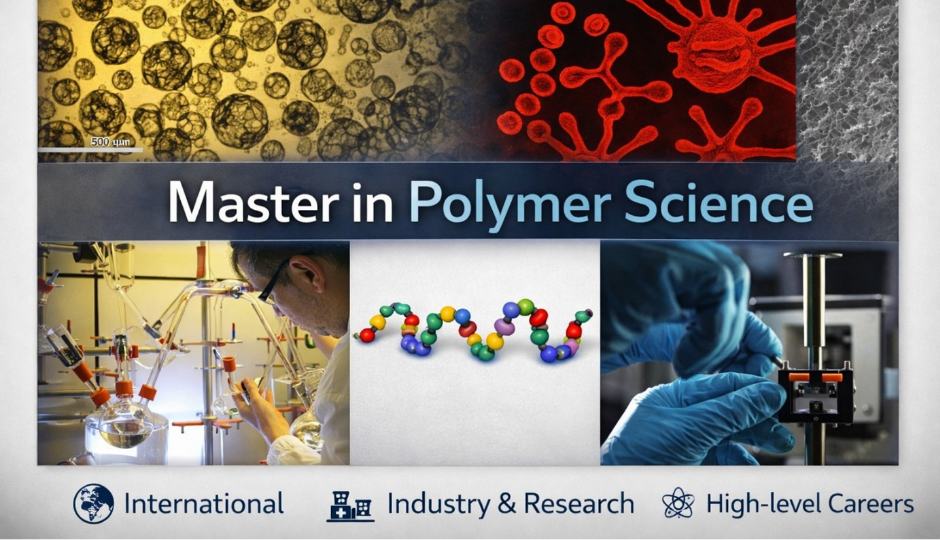
Polymer Science – exemples © Guillaume FLEURY
A high-level international track in polymer science
The DMIPS program offers an excellent European-level education in polymer science through a two-year international curriculum leading to two Master’s degrees awarded by partner universities in the Basque Country and Bordeaux. This unique structure allows students to experience two complementary academic environments, benefit from courses taught in English, and develop strong international and intercultural skills highly valued by employers. The program provides comprehensive training covering polymer chemistry, physical chemistry, materials science and engineering. Students acquire a global and integrated vision of polymer materials, from molecular design to structure–property relationships. The international dimension of the program also fosters adaptability, autonomy and scientific maturity, preparing graduates for careers in a highly competitive and globalized scientific landscape, whether in Europe or beyond.
DMIPS is designed to train students at the interface between fundamental research and industrial innovation. The curriculum combines solid theoretical foundations with advanced experimental approaches, addressing current scientific and technological challenges in polymer science. Students acquire in-depth knowledge of structure–property relationships, polymer processing, self-assembly, crystallization and advanced characterization techniques. This scientific training is reinforced by the development of research-oriented skills such as data analysis, critical thinking, project management and scientific communication in English. Internships carried out in academic laboratories or industrial R&D centers allow students to apply their skills to real-world problems and to become familiar with professional research environments. This balanced exposure enables graduates to pursue either a PhD or immediate employment in industrial R&D with a strong scientific background.
Excellent career prospects in a strategic and evolving industrial sector
Polymers play a central role in modern society, with applications spanning packaging, transportation, energy, electronics, construction, healthcare and advanced manufacturing. Europe hosts a major and dynamic polymer industry, offering a wide range of career opportunities in large industrial groups, SMEs, start-ups and research centers, with strong global connections. At the same time, the polymer sector faces major scientific, technological and societal challenges, including polymer recycling, circular economy strategies, bio-based and biodegradable polymers, and the development of sustainable and high-performance materials. The DMIPS program prepares students to actively contribute to these challenges by providing them with a strong scientific foundation and a forward-looking vision of polymer science. As a result, graduates of the DMIPS program are well positioned for high-level careers in industry, research and innovation, as well as for doctoral studies. They enter a field with strong employment demand and the opportunity to contribute meaningfully to the transition toward more sustainable materials and technologies.
Graduates of the DMIPS program acquire strong scientific and technical skills in polymer chemistry, physico-chemistry, materials science, processing and advanced characterization, combined with analytical thinking, project management and scientific communication in English.
These competencies open access to a wide range of positions, including R&D engineer, materials specialist, technical consultant, innovation manager or project leader, in industrial companies, research centers and technology-driven start-ups.
The program also provides excellent preparation for research-oriented careers, particularly through internships and close interaction with academic laboratories. Graduates are well positioned to pursue doctoral studies or to participate in collaborative research projects addressing major challenges such as sustainable polymers, recycling, energy materials and advanced functional systems.
To better understand the program’s objectives and modules
Dernière mise à jour :